
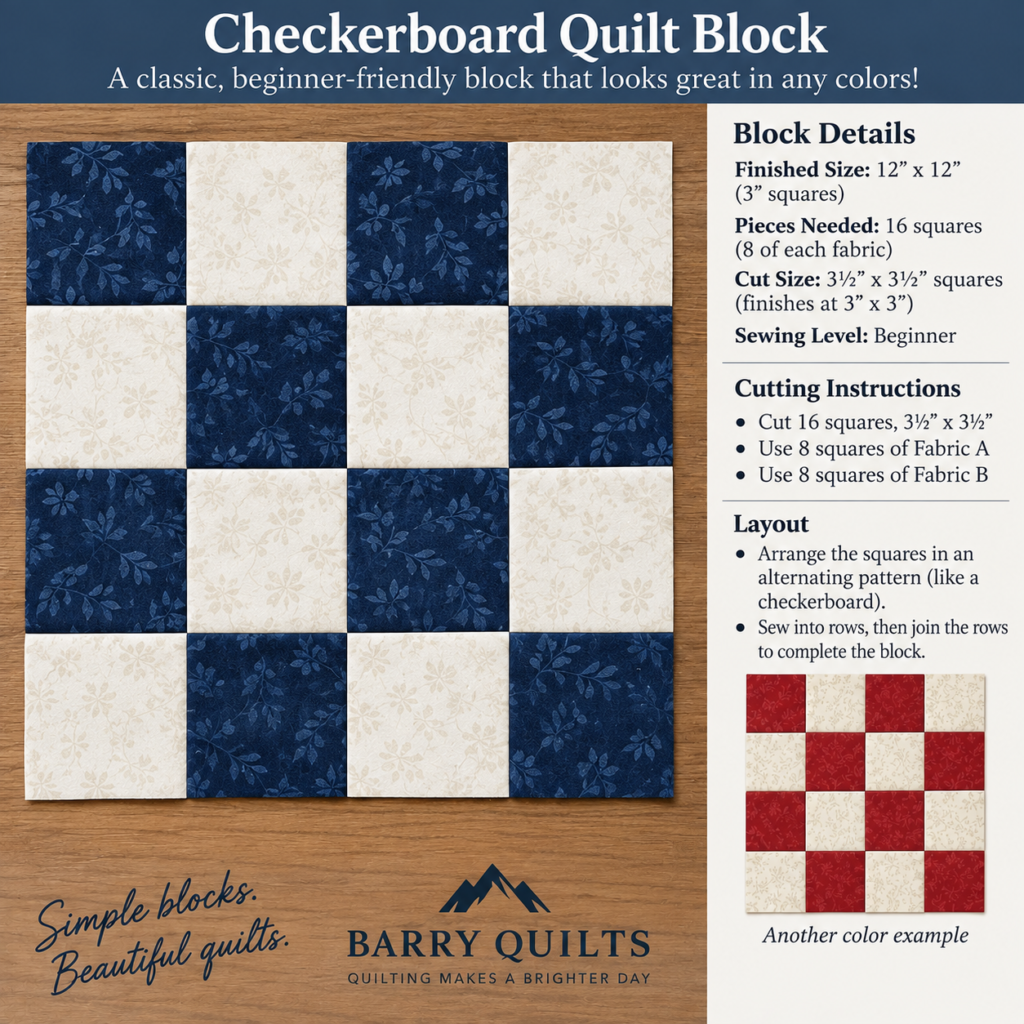
The Checkerboard quilt block is about as straightforward as quilting gets, but that simplicity is exactly what makes it so useful. Made from alternating light and dark squares, it creates the familiar look of a checkerboard while teaching several basic quilting skills at the same time.
For a beginner, this is a great block to make after learning a four-patch and nine-patch because it uses the same basic idea on a slightly larger scale.
Making a 12-Inch Finished Checkerboard Block
For this version, the block is arranged in four rows of four squares.
You will need:
- 8 squares from Fabric A, cut at 3½ × 3½ inches
- 8 squares from Fabric B, cut at 3½ × 3½ inches
Each square finishes at 3 × 3 inches after the ¼-inch seam allowances are sewn.
Four finished 3-inch squares across gives you a finished block measuring:
12 × 12 inches
Arrange the squares so the two fabrics alternate from one position to the next. The second row begins with the opposite fabric, creating the checkerboard effect.
You can sew the squares together individually, but another option is strip piecing. Strips of the two fabrics can be sewn together, cut into sections, and rearranged. That technique can make larger checkerboard projects much faster.
A Block With a Long History
It is difficult to point to one person or one date and say that is when the Checkerboard quilt pattern was invented. Alternating squares are such a basic geometric design that similar patterns have appeared in textiles for centuries.
There is evidence that checkerboard-style designs were being used in American quilts well before the Civil War. Historic New England has a checkerboard-pattern quilt top dated approximately 1780–1840, showing just how far back the design goes in American quilting. (Historic New England)
Examples continued throughout the nineteenth century. North Carolina historical records describe a pieced checkerboard quilt dating to about 1850–1860, made from brown and blue plaid fabrics. Like many quilts of the period, it may have made practical use of fabric left over from clothing and household sewing. (NCPedia)
The Illinois State Museum also preserves a checkerboard quilt made around 1865 by Hester Wright of Marshall County, Illinois. Its top was pieced from cotton fabric and then hand quilted. (Story of Illinois)
Another museum collection documents a checkerboard-pattern quilt from about 1870, demonstrating that the arrangement remained familiar throughout the nineteenth century. (Potsdam Museum)
Checkerboard arrangements continued into the twentieth century as well. The Smithsonian’s Anacostia Community Museum holds a twentieth-century quilt made from hundreds of brightly colored squares arranged in a checkerboard pattern. (Anacostia Community Museum)
So while we may not know exactly who first made a Checkerboard quilt, we do know that the basic design has been part of quilting for generations.
Why the Checkerboard Is a Good Beginner Block
The biggest advantage of the Checkerboard block is that there are no triangles, curves, or complicated templates.
The main skills are simply cutting accurate squares, sewing a consistent ¼-inch seam, matching intersections, and keeping the fabrics in the proper order.
That makes it a good practice block for learning how seams come together. Pressing adjoining seams in opposite directions can also help those intersections nest together neatly.
And even though the construction is simple, changing the fabrics can completely change the look.
Two solid colors give it the traditional game-board appearance. Floral prints can make it softer and more traditional, while bright colors or modern prints can make the same block look completely different.
Simple Doesn’t Mean Boring
One of the nice things about quilting is that some of the simplest blocks can produce beautiful quilts.
A single Checkerboard block may not look complicated, but repeat that block across an entire quilt and suddenly you have a strong geometric design. You can also alternate Checkerboard blocks with solid blocks, stars, appliqué blocks, or other pieced designs.
And because the block uses basic squares, it is also a great way to use scraps.
For beginning quilters, the Checkerboard is a good reminder that you don’t need complicated piecing to make something worth being proud of.
Sometimes sixteen simple squares are all you need.


